Upon invitation, between November 6 and 12, Vice President Han Zheng will travel to Türkiye to attend the Antalya Leaders’ Summit at the 31st meeting of the Conference of the Parties to the UN Framework Convention on Climate Change as Special Representative of President Xi Jinping, and visit Georgia.
CCTV: To follow up on your announcement that Vice President Han Zheng will travel to Türkiye to attend the Antalya Leaders’ Summit at the 31st meeting of the Conference of the Parties to the UN Framework Convention on Climate Change (COP31) as Special Representative of President Xi Jinping, can you share more information and China’s expectation for the summit?
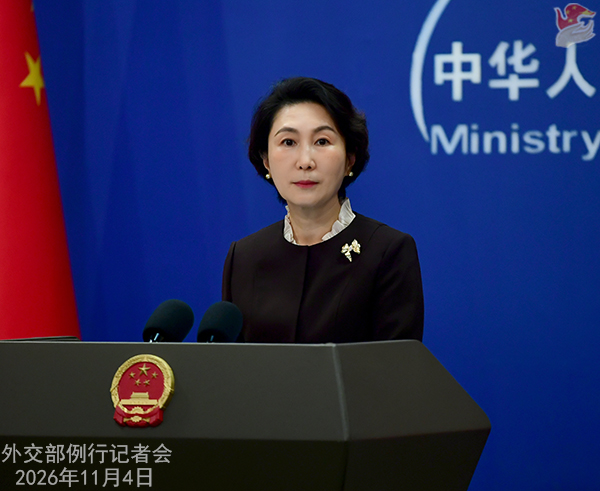
Mao Ning: COP31 will soon be held in Antalya, Türkiye. Vice President Han Zheng will attend the Antalya Leaders’ Summit as Special Representative of President Xi Jinping and work with leaders of other countries to provide political guidance for the meeting.
The Paris Agreement enters its second decade this year. The meeting will mainly discuss how to strengthen implementation, accelerate action and promote cooperation in the new decade. China stands ready to work with various parties to firmly uphold multilateralism, fully implement the UNFCCC and the Paris Agreement, strengthen practical climate action, and contribute to the success of the meeting.
The New York Times: What is China’s view of the Congressional elections that just happened in the United States? Do you see any fresh possibilities in U.S.-China relations?
Mao Ning: The U.S. midterm elections are a domestic affair. China stands ready to continue working with the U.S. to uphold and deliver on the important common understandings reached by the two heads of state, enhance communication, properly manage differences, expand cooperation, and build a constructive relationship of strategic stability on the basis of respect, fairness, and reciprocity.
Xinhua News Agency: We noted that recently Saudi National Security Advisor Mosaad bin Mohammad Al-Aiban and Deputy Secretary of Iran’s Supreme National Security Council Ali Bagheri Kani were in China at the same time. What is China’s view on Saudi Arabia-Iran relations and the situation in the Middle East and Gulf region?
Mao Ning: A few days ago, Member of the Political Bureau of the CPC Central Committee and Director of the Office of the Central Commission for Foreign Affairs Wang Yi met with Saudi and Iranian national security officials respectively in Beijing to have in-depth exchanges of views on the situation in the Middle East and Gulf region. China believes that stability in the Middle East and Gulf region bears on not only the well-being of countries and people in the region, but also international energy supply and world peace and security. Amid escalating tensions in the Middle East, China is ready to step up communication and dialogue with Saudi Arabia, Iran and other regional countries. The pressing priority is to avoid resumption of conflicts in the Middle East, which will inflict great suffering on the people in the region. China will continue to follow the guidance of the initiatives and propositions put forward by President Xi Jinping on promoting peace and security in the Middle East, uphold an objective and fair position, support Iran and the U.S. in resolving disputes through negotiations, promote the political settlement of the Yemen issue, and facilitate efforts to seek a proper and comprehensive settlement on the opening of the Strait of Hormuz. It is our hope that regional countries will uphold the principles of mutual respect and good-neighborliness, jointly create a new regional architecture for common, comprehensive, cooperative and sustainable security, and realize lasting peace in the region.
Both Saudi Arabia and Iran highly commended President Xi Jinping’s initiatives and propositions on promoting peace and security in the Middle East, expressed the willingness to maintain dialogue and communication with various parties in the spirit of the Beijing Agreement, and welcomed China’s continued efforts to play a constructive role.
China News Service: To follow up on Vice President Han Zheng’s visit to Georgia you just announced, could you share the background and program? What are China’s expectations for the visit?
Mao Ning: China and Georgia are comprehensive strategic partners. In recent years, guided by the blueprint mapped out by leaders of the two countries, bilateral relations have grown rapidly, with cooperation in various fields yielding fruitful outcomes. During this visit, Vice President Han Zheng will exchange views with the Georgian leadership on bilateral ties and issues of mutual interest. China stands ready to work with the Georgian side to fully implement the important common understandings reached by leaders of the two sides, deepen mutually beneficial cooperation, and maintain the sustained growth of bilateral relations for the benefit of both peoples.
AFP: According to reporting by the Financial Times, officials in Beijing, Moscow and Washington have been working to schedule talks between the three presidents on the sidelines of APEC in Shenzhen. Can the Chinese foreign ministry confirm this?
Mao Ning: China is in communication with relevant parties regarding a meeting between the three heads of state.
Phoenix TV: It’s reported that on October 3, Britain’s National Cyber Security Centre, which is part of the Government Communications Headquarters, issued the annual report on cybersecurity, saying that China is a leading developer of AI-cyber capability. By 2028, it is “highly likely” that China will routinely use AI-cyber to carry out hacking activities, which represents the “most sophisticated and sustained” cyber challenge facing the UK. What’s your comment?
Mao Ning: We noted the relevant reports. China expresses grave concern over the wanton speculative accusation brought by the UK despite the absence of evidence.
AI-generated cybersecurity risks are a global challenge and require new rules formulated at the UN to form a global response. Regrettably, the UK, having long politicized the cybersecurity issue, is now rehashing hacking allegations as a pretext to curb China’s AI development. This type of action is not helpful for increasing mutual trust between China and the UK, and hurts the UK’s credibility when it comes to cooperation on global AI security governance.
China believes that the development of AI should be open and for progress, for good and for all, aim at both security and advancement, and ensure it is safe, reliable and controllable.